

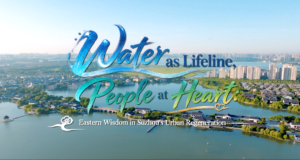
China’s urbanization has entered a new phase. For Suzhou, a renowned Jiangnan city with 2,500 years of history, this transition has become a pressing yet promising challenge. Suzhou’s development path is intrinsically shaped by its dense network of waterways.
“The heart of Suzhou is water – intangible cultural heritage born of water, a way of life where people and water coexist, and a traditional culture sustained by water,” says Juan Carlos Dall’Asta, Head of the Department of Architecture at Xi’an Jiaotong-Liverpool University (XJTLU).
This water-centric identity is visibly reflected in the city’s dual structure: on one hand, the ancient Gusu district, laid out by Wu Zixu over two millennia ago, still preserves its historic parallel water-street grid; on the other, the Suzhou Industrial Park (SIP), barely 32 years old, was developed from the ground up and has undergone multiple rounds of industrial upgrading.
What makes Suzhou’s development distinctive is its commitment to green principles. Rather than filling in Jinji Lake to maximise industrial land, the city dredged and expanded it, turning it into a free, ecologically vibrant “green heart” for public enjoyment.
Around 2003, SIP established the Dushu Lake Higher Education Town, which brought in more than 10 universities and research institutes, including XJTLU. This move broke the conventional “industry-first” logic and instead built a complete innovation chain: fundamental research at universities and institutes, commercialization via incubators, and large-scale industrial application through manufacturing enterprises. Suzhou’s development is neither a replication of Western models nor a rupture with its past – it is a locally adapted path that respects its historical fabric while embracing modernity.
Local Universities as Witnesses and Drivers of Suzhou’s Transformation
Suzhou’s urban regeneration is not merely a government-led project – it is being actively observed, studied, and shaped by local higher education institutions. XJTLU, as a key player in the Dushu Lake education cluster, has become both a witness and a catalyst in this process.
Marc Aurel Schnabel, Dean of XJTLU’s Design School, explains that his research teams are deploying advanced technologies to provide evidence-based recommendations for local policymakers. “Our teams study how climate change and the urban heat island effect impact Suzhou’s local environment. We use drones to capture thermal imaging of the city, build digital models to simulate airflow, and develop mitigation solutions. We also research building energy efficiency, using digital simulations to identify critical energy-saving opportunities,” he says.
Schnabel, who came to China from Europe, emphasises that the scale and speed of China’s urban construction far exceed those in Europe. “China has a ‘can-do’ attitude, is willing to try new things, and is an excellent testing ground for new ideas,” he notes, pointing to the country’s leadership in AI and digitalization. “When I came here, the first thing was to respect and understand the local culture – only then could I consider whether my own experience could contribute to China.” His remarks reflect a broader trend: Suzhou’s universities are not passive observers but active contributors, bridging global expertise with local realities.
Moreover, XJTLU’s urban planning team has drawn international attention. According to Chen Bing, Head of the Department of Urban Planning and Design, overseas cities such as Suwon in South Korea have already shown interest in learning from Suzhou’s development experience. This indicates that China’s homegrown urban regeneration solutions – rooted in local conditions and powered by academic research – are beginning to offer new reference points for cities around the world.
People-Cente Regeneration: The Core of Suzhou’s Urban Transformation
As China’s urban regeneration evolves from large-scale demolition and reconstruction – the “hard renovation” phase – to a “soft regeneration” measured at a human scale, Suzhou exemplifies this shift in philosophy. The ultimate benchmark for success, as the city’s practice shows, is whether residents can live and work in contentment.
Suzhou’s approach is defined by three principles: respecting historical fabric, activating ecological networks, and preserving cultural warmth. The ancient water towns, the preserved alleyways, and the publicly accessible lakes are not merely relics but living spaces that continue to support daily life. Meanwhile, the new districts are planned with pedestrian-friendly streets, green corridors, and mixed-use communities that prioritise quality of life over pure economic output.
The transition from urban expansion to improving existing urban areas means that regeneration projects now focus on retrofitting existing neighbourhoods, improving public facilities, and enhancing environmental resilience – all with active community participation. Local authorities have adopted a “micro-regeneration” strategy in many historic blocks, repairing rather than replacing, and upgrading infrastructure while preserving the original social fabric.
This people-first mindset is also reflected in the city’s open spaces: Jinji Lake and Dushu Lake are not gated parks but freely accessible public realms where citizens gather, exercise, and connect with nature. As Dall’Asta notes, Suzhou’s culture is born of water – and that culture belongs to everyone. The city’s regeneration does not aim for a glossy, homogeneous modernity; instead, it seeks a balanced, inclusive, and resilient urban environment where tradition and innovation coexist harmoniously.
Suzhou’s urban regeneration path offers a compelling lesson: successful regeneration is not about erasing the old in favour of the new, but about weaving the two together in a way that serves the real needs of people – today and for generations to come. This is the essence of a Chinese approach to urban regeneration: one that neither copies nor cuts off, but adapts and endures.



More Stories
Coca-Cola Supports 458,200 Jobs Across COMESA in $3.6 Billion Economic Contribution
From AI to Battery Life: What Makes the Samsung Galaxy A08 LTE an Everyday Companion
Samsung Expands Budget Smartphone Range in Kenya With Galaxy A18, A08 LTE